

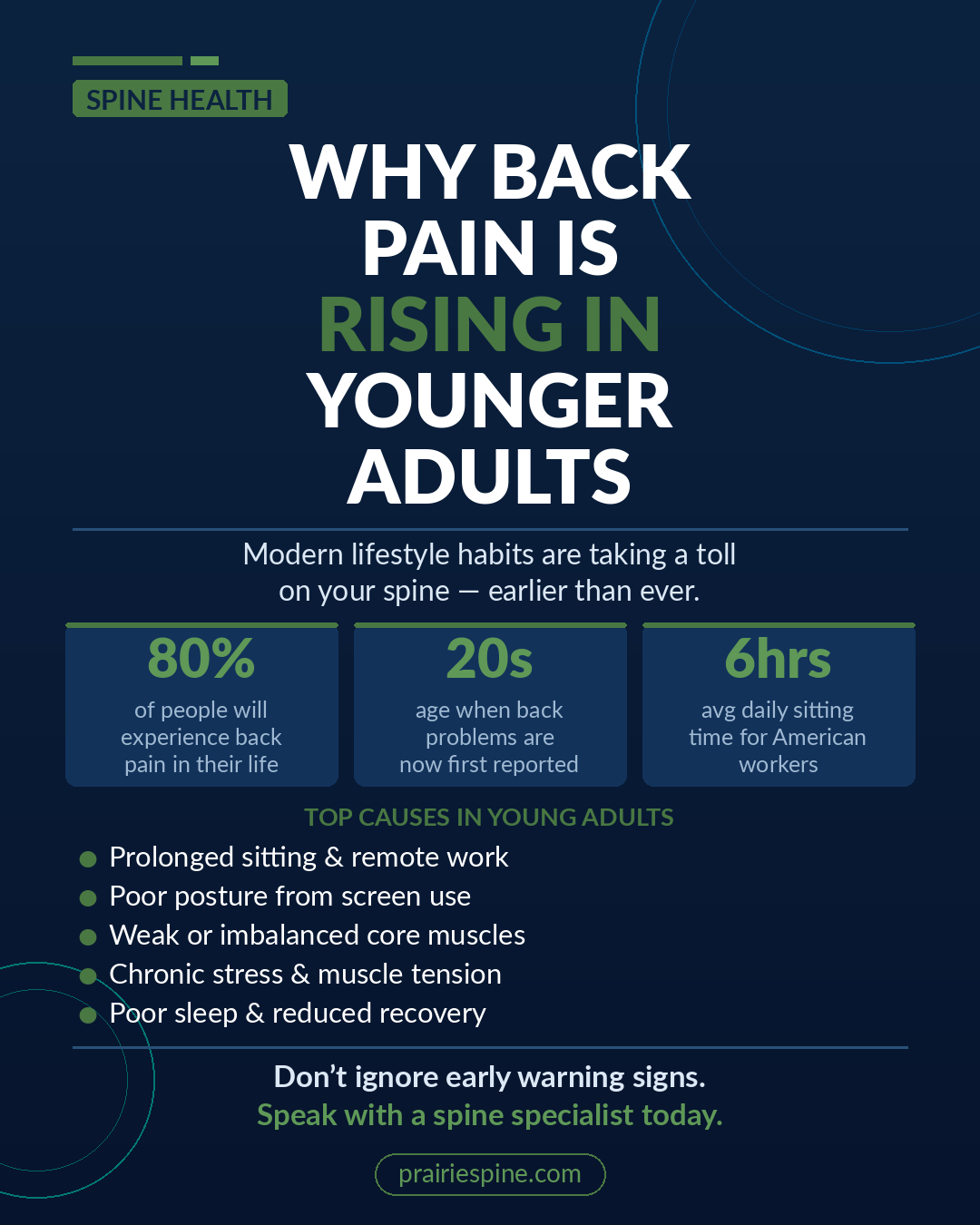
 Back pain was once considered a condition that arrived with age, but that assumption no longer holds. Back pain in younger adults is now one of the most commonly reported musculoskeletal complaints in the United States. Millions of people in their 20s and 30s are visiting doctors, missing work, and limiting daily activities because of spinal discomfort that was rarely seen in this demographic a generation ago. The causes are largely rooted in how modern life has reshaped the way we move, sit, sleep, and manage stress. Understanding these contributors is the first step toward preventing long-term spinal damage.
Sedentary Lifestyles and Spine Load
The average American now spends more than six hours a day sitting, a figure that climbs higher for those who work desk jobs or commute long distances. Prolonged sitting compresses the intervertebral discs and places significant strain on the lumbar region of the spine. Unlike standing or walking, sustained sitting reduces blood flow to spinal tissues and weakens the postural muscles that normally support the vertebral column. Remote work has made this worse by eliminating many of the incidental movements that office environments once provided, such as walking to meetings or moving between floors. Without deliberate effort, a person can spend the majority of their waking hours in a position that gradually degrades spinal health. The cumulative effect of years of sedentary behavior shows up as disc degeneration, herniation, and chronic lower back pain well before middle age.
Screen Time and Postural Damage
Smartphones, tablets, and laptops have introduced a posture pattern that spine specialists now recognize as a distinct risk factor. When a person looks down at a phone, the effective weight placed on the cervical and upper thoracic spine can increase to 50 or 60 pounds, compared to the roughly 10 to 12 pounds the head places on an upright spine. This repeated forward head position strains the muscles and ligaments of the neck and upper back and, over time, alters spinal curvature. The problem is not limited to the neck; slumping while scrolling or gaming also rounds the lower back, reducing the natural lumbar curve and increasing disc pressure. Young adults now spend an average of seven or more hours daily on screens outside of work, making this one of the most consistent contributors to early spinal problems. Small adjustments in screen positioning and usage habits can have a measurable impact on long-term spinal health.
Weak Core Muscles and Imbalance
The muscles of the abdomen, pelvis, and lower back form a system that stabilizes the spine during virtually every movement. When these muscles are weak or imbalanced, the spine compensates by absorbing forces it is not designed to handle alone. Many younger adults have significant muscular imbalances resulting from irregular physical activity, poor exercise form, or fitness routines that prioritize appearance over function. Overtraining the chest and hip flexors while neglecting the glutes and deep abdominal muscles is a common pattern that pulls the pelvis into an anterior tilt, increasing lumbar stress. Even people who exercise regularly may unknowingly be training in ways that worsen their postural mechanics. A weak core is one of the most treatable causes of back pain, but it requires targeted intervention rather than general fitness activity alone.
Stress and the Spine
Psychological stress has a measurable effect on the body’s experience of pain. Chronic stress elevates cortisol levels, increases muscle tension, and alters pain perception, all of which can amplify or sustain lower back discomfort. Research has shown that people who report high levels of workplace stress, anxiety, or sleep disruption are significantly more likely to develop musculoskeletal pain, including in the back. For younger adults, financial pressure, career demands, and the pervasive influence of social media have created a generation managing elevated baseline stress levels. Muscle guarding, in which the body tenses muscles around vulnerable areas as a protective response, is a physical manifestation of chronic stress that can lead to spasm and restricted movement. Addressing the psychological component of back pain is not optional; it is a necessary part of effective treatment and prevention.
Sleep Quality and Spinal Recovery
Tissue repair in the spine, as throughout the body, occurs primarily during sleep. During deep sleep, the intervertebral discs rehydrate and the muscles surrounding the spine recover from daily demands. When sleep is consistently poor in duration or quality, this restorative process is interrupted, and spinal structures do not recover at the same rate they are being stressed. Younger adults report some of the worst sleep habits of any age group, driven by irregular schedules, excessive screen use before bed, and high caffeine consumption. Poor sleep also lowers the body’s pain threshold, meaning that even minor spinal irritation is perceived more acutely. Over time, chronic sleep deprivation accelerates disc degeneration and leaves the musculature in a persistently fatigued state. Improving sleep hygiene is one of the most straightforward interventions available for protecting long-term spinal health.
Building Better Daily Habits
Prevention does not require dramatic lifestyle changes, but it does require consistency. Setting a reminder to stand and move for a few minutes every hour can meaningfully reduce the compressive load on the lumbar discs over the course of a workday. Strengthening exercises that target the deep core, particularly the transverse abdominis and multifidus muscles, are well-supported by research as effective preventive measures. Adjusting screen habits, including raising the phone to eye level and configuring an ergonomic workstation, removes a significant and ongoing source of cumulative spinal stress. Maintaining a healthy body weight reduces the load the spine carries and decreases the risk of disc degeneration over time. Back pain in younger adults responds well to early intervention, and most cases can be managed or resolved without surgery when addressed promptly. Consulting a spine specialist sooner rather than later is the most reliable way to understand what is driving discomfort and to build a practical plan.
The Path Toward Prevention
The rise of back pain in younger adults is not an inevitable outcome of modern life. It is largely the product of specific, identifiable lifestyle patterns that can be changed with the right guidance and support. Prairie Spine and Pain Institute offers personalized evaluation and care for patients at every stage of spinal health, from early prevention to complex treatment. If you are experiencing back pain and are not sure where to start, a consultation with one of our specialists can give you the clarity and direction you need.